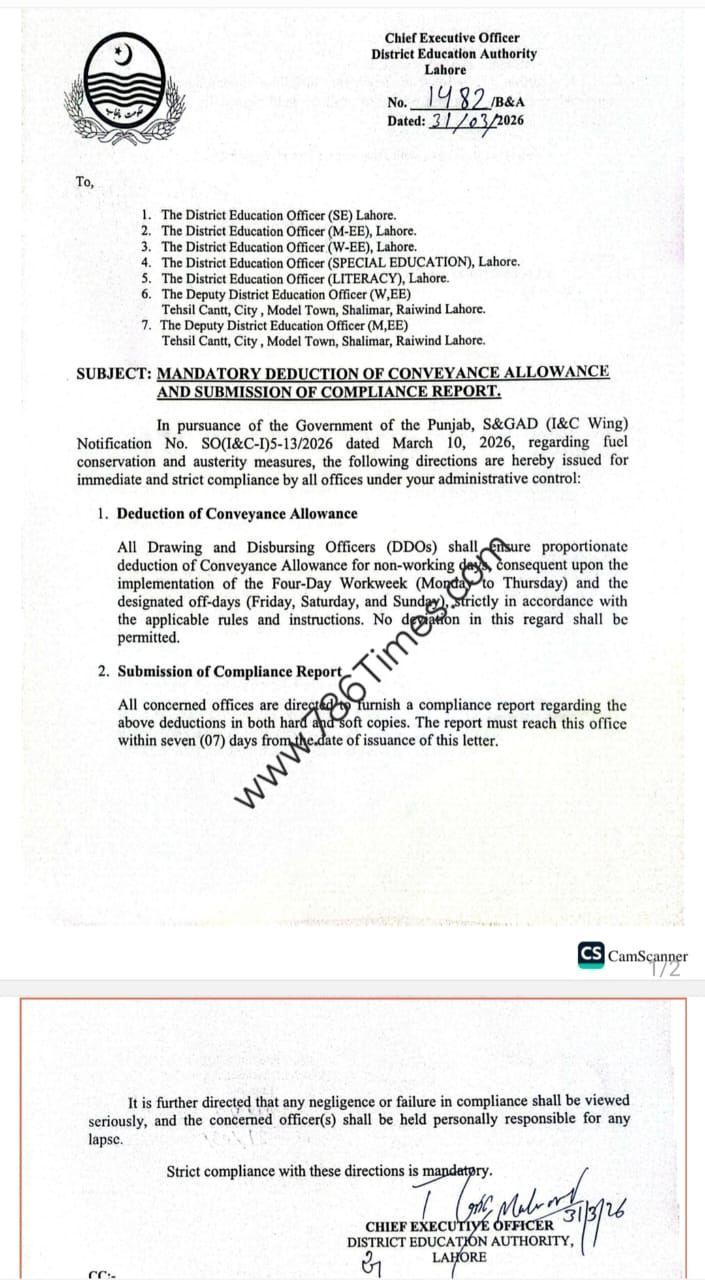
In pursuance of the Government of the Punjab, S&GAD (I&C Wing) Notification No. SO(I&C-1)5-13/2026 dated March 10, 2026, regarding fuel conservation and austerity measures, the following directions are hereby issued for immediate and strict compliance by all offices under your administrative control:
1. Deduction of Conveyance Allowance
All Drawing and Disbursing Officers (DDOs) shall ensure proportionate deduction of Conveyance Allowance for non-working days, consequent upon the implementation of the Four-Day Workweek (Monday to Thursday) and designated off-days (Friday, Saturday, and Sunday), strictly in accordance with the applicable rules and instructions. No deviation in this regard shall permitted.
2. Submission of Compliance Report
All concerned offices are directed to furnish a compliance report regarding the above deductions in both hard and soft copies. The report must reach this office within seven (07) days from the date of issuance of this letter.
It is further directed that any negligence or failure in compliance shall be viewed seriously, and the concerned officer(s) shall be held personally responsible for any lapse.
Conveyance Allowance Deduction Policy Introduced Under Punjab’s Fuel Conservation Plan
Conveyance allowance deduction has become a key administrative reform after the Government of Punjab introduced new austerity measures aimed at reducing fuel consumption and controlling public expenditure. The directive follows a notification issued by the Services and General Administration Department (S&GAD), instructing all government departments to deduct transport allowances proportionately during newly designated non-working days under the four-day workweek policy.
The order emphasizes strict compliance across government offices. Authorities say the policy is designed to conserve energy resources, reduce operational costs, and promote responsible governance during challenging economic conditions.
Background of the New Policy
According to the official notification issued on March 10, 2026, the policy forms part of broader austerity measures implemented to address rising fuel costs and fiscal pressure. The directive instructs all Drawing and Disbursing Officers (DDOs) to deduct conveyance allowances for employees during designated off-days.
Under the revised schedule, government offices will operate four days a week, from Monday to Thursday. Friday, Saturday, and Sunday will be treated as official off-days. As a result, employees receiving transport allowances will see a proportionate deduction for the days they do not commute to work.
This administrative step reflects a wider strategy that governments around the world are exploring. Several countries have introduced flexible working schedules to reduce energy consumption and improve workplace efficiency.
How the Conveyance Allowance Deduction Works
The conveyance allowance deduction policy applies to all government departments operating under the administrative control of the Punjab government. Drawing and Disbursing Officers are responsible for calculating and implementing deductions based on the number of non-working days.
Officials have been instructed to ensure strict adherence to the applicable financial rules. The notification clearly states that no deviation from the deduction policy will be permitted.
The policy is intended to reflect the practical reality that employees do not incur transportation costs on days when offices remain closed. Therefore, the allowance adjustment ensures public funds are spent responsibly.
Mandatory Compliance Report Requirement
In addition to implementing the deductions, all departments must submit a compliance report confirming that the instructions have been executed.
Government offices have been given seven days from the issuance of the directive to send the report in both hard copy and digital format. Authorities have warned that failure to comply with the instructions could result in disciplinary action against responsible officials.
The move highlights the government’s intention to enforce financial discipline across public institutions.
Fuel Conservation and Economic Challenges
Fuel conservation has become a priority for many governments worldwide as energy prices remain volatile. Rising global oil costs and economic pressures have forced policymakers to consider cost-saving strategies within the public sector.
Administrative reforms such as reduced office days, remote work arrangements, and tighter expense controls are increasingly common in both developed and developing economies.
International reporting by organizations like AP News has highlighted similar measures adopted by governments seeking to manage public spending while improving efficiency.
Impact on Government Employees
For government employees, the conveyance allowance deduction policy represents a financial adjustment rather than a salary reduction. The allowance specifically covers transportation expenses incurred while commuting to the workplace.
Because the new workweek reduces commuting days, authorities argue that the deduction simply aligns the allowance with actual transportation usage.
However, some employees have expressed concerns about the potential impact on household budgets. Labor experts say communication and transparency will play an important role in ensuring that workers understand the rationale behind the policy.
Global Trends in Four-Day Workweek Policies
The concept of a four-day workweek has gained popularity across many regions including Europe, North America, and Asia. Governments and corporations are experimenting with alternative schedules to improve productivity and employee well-being.
In several countries, pilot programs have shown that shorter workweeks can reduce operational costs while maintaining or even improving efficiency.
Although the policy in Punjab is primarily linked to fuel conservation and austerity measures, it also reflects a broader global trend toward flexible work arrangements.
Administrative Accountability and Governance
The Punjab government has emphasized that strict accountability will accompany the implementation of the deduction policy. Officials responsible for payroll administration must ensure that all financial adjustments comply with existing regulations.
Any negligence in implementing the instructions could result in disciplinary action against the concerned officers.
This approach underscores the importance of transparency and responsible financial management in public institutions.
Public Finance and Cost-Cutting Measures
Economic analysts say austerity measures in the public sector often aim to balance budgets without affecting essential services. Adjusting allowances rather than basic salaries is considered a more flexible approach to controlling expenditures.
The conveyance allowance deduction policy therefore represents a targeted strategy to reduce government spending while maintaining operational capacity.
Such measures may also encourage departments to adopt digital communication and remote collaboration tools, further reducing operational costs.
Future Outlook
The success of the policy will largely depend on how effectively government departments implement the deduction system and submit compliance reports.
If the initiative successfully reduces fuel consumption and administrative costs, it could inspire similar reforms in other provinces or countries facing comparable economic challenges.
Observers note that governments across the world are increasingly experimenting with innovative administrative reforms to manage limited resources more effectively.
Conclusion
The introduction of the conveyance allowance deduction policy marks a significant step in Punjab’s efforts to promote fiscal discipline and energy conservation. By linking transport allowances directly to working days, the government aims to ensure that public funds are used responsibly.
While the policy may require adjustments for government employees, it reflects a broader effort to modernize administrative systems and address economic realities. As departments submit compliance reports and implement the new rules, the initiative will serve as a key test of the government’s commitment to financial accountability and sustainable governance.
Related News
- Latest Pakistan News – 786Times
- World News Updates
- Political Developments
- Economic News Analysis
- Opinion & Editorials
- About 786Times